Follow us

The Tour That Ended The Beatles’ Touring

Sixty years ago, the Beatles had just completed work on their groundbreaking album Revolver, and the band reluctantly agreed to dates in Asia and North America for a limited summer tour in 1966. Having more interest in spending time experimenting in the studio, John Lennon (along with George Harrison, occasionally) raised the idea of quitting touring altogether within the band’s camp. This notion would haunt the tour for the next two and a half months.
The Beatles never had a good feeling about the tour. It began on June 22 in Munich. Displaying where their minds were, they spent their first day on the road debating what they should call their new album (Magic Circle and Abracadabra were Paul’s ideas; Ringo humorously suggested After Geography, a play on the recent Rolling Stones’ release Aftermath.) The next evening, they hit the stage, fighting to hear themselves over the screaming fans. Uninspired in their performance, they were often out of tune and forgetting lyrics. They only played old hits and no songs from Revolver.
Once done in Germany, they took a grueling sixteen-hour flight, arriving at Tokyo’s Haneda Airport. The band instantly noticed that security was exceptionally tight. Right-wing nationalist groups had already made violent threats. Their beef was that the Beatles had been booked at the Budokan, an arena built to preserve Japanese cultural events.
Fortunately, the Beatles faced no dangerous incidents but played in the same lackluster manner they had in Germany.
Pushing ahead, they arrived in Manila, Philippines, on July 3rd. The Beatles left their plane the normal way, but before they could collect their bags, the band members were aggressively guided to a waiting car. The driver drove away, separating them from their assistant Neil Aspinall and manager Brian Epstein. This immediately concerned the Beatles, as they did not know why they were separated or where they were going… and they knew they had stashed pot in those bags.

Eventually the band was ushered into the Philippine Navy Headquarters where forty journalists were waiting to commence an unplanned press conference. (Question: “What is the name of your next song?” – Answer: “Philippine Blues”). By the time Brian Epstein caught up with the group, they had been ushered onto a yacht, the Marima. Furious at having to pay a bond on the band’s equipment back at the airport, Brian refused any further picture-taking of the band. The next morning, the apparent conflicts would come to a head.
The Beatles were unaware that the Manila Times had announced that they would be visiting the country’s Presidential Palace at 11 am. This was a big event as President Ferdinand Marcos and his wife Imelda would meet the famous band. The formidable Imelda had invited three hundred children, with a plan for the Beatles to then proceed directly to the stadium for their concert.
These lofty plans were never discussed with Brian or the Beatles. It seems that Philippines promoter Ramon Ramos had been told by the palace to deliver the Beatles, but knowing the invitation would likely be declined by the Beatles’ camp, he stalled, burying the invitations in small print in their contract. His hope was that there would be a compromise on the day…and that day had come. Brian Epstein made an immediate but polite turn-down to their invitation, as the Beatles had made a practice of declining invitations to such official events.
This prompted a military-dressed team from the palace to arrive at the hotel room of the promoter, banging on the door with, “This is not a request. We have our orders.” Once the promoter caught up with Brian, Epstein proclaimed, “Go back and tell the generals we’re not coming.” The Beatles went on to perform their two poorly amplified shows that evening at the Rizal Memorial Football Stadium.
The next morning, the Beatles were getting ready to fly to India for an overnight stay en route to London. They’d packed their bags and waited for their ground transfer to the airport. Meanwhile, the morning papers screamed, “FUROR OVER BEATLES’ SNUB,” and described their invitation refusal as a sign of disrespect to their President and country. By 8 AM, no limos had come to pick them up. They were on their own.
Road Manager Mal Evans managed to hail a set of taxis, and upon arriving at the airport they found that the escalators had been turned off. Porters refused to carry any Beatles’ luggage, leaving them to struggle to get through the crowds of people who had seemingly turned a nasty eye toward the band. The sight of four “disrespecting” Beatles fleeing their country heated the tensions that finally burst into fists being thrown at the members of the band, plus Brian Epstein, Neil Aspinall and Mal Evans.
Once making it to the plane, the Beatles kissed their seats, happy it was all over, and clearly angry at Epstein’s handling of the situation. When they made it home to London, Brian was a mess. He’d broken out in rashes, was running a fever, and showed signs of serious anxiety. His doctor recommended rest. He would soon check himself into Portmeirion in North Wales, a tourist village on the sea.

In Brian’s absence, talk of revisiting the reasons for touring began. The conversations got increasingly serious when Neil told them that Brian was already making plans for a 1967 tour. “No more for me.” Was John’s early view, “I say we stop touring!”
Little did John know that he’d already laid the land mine that led to the Beatles ending touring forever.
That had occurred in March when the UK’s Evening Standard reporter Maureen Cleave was granted unprecedented access to the four most popular people in the world, and wrote a 4-part feature. With John, religion worked its way into the conversation:
“Christianity will go. It will vanish and shrink. I needn’t argue about that; I’m right, and I will be proved right. We’re more popular than Jesus now; I don’t know which will go first- rock and roll or Christianity. Jesus was all right, but his disciples were thick and ordinary. It’s them twisting it that ruins it for me.”
When printed in the UK, the remarks were hardly noticed. The articles were subsequently picked up by the American pop magazine Datebook just weeks before the Beatles were to return to the US.
But when the article caught on in the conservative southern states, it caused a backlash. Two DJs from WAQY in Birmingham, Alabama (Tommy Charles and Doug Layton) began on-air rebukes of the Beatles’ beliefs. They soon organized bonfires in their area for listeners who wanted to burn Beatles records.

Soon the protests gained momentum when United Press International (UPI) caught on, and the story spread throughout America. While still rehabbing at Portmeirion, Brian Epstein was told by his New York office, “This is getting a little out of hand here. The Beatles better watch out when they hit the Southern States.” Anonymous death threats had already been issued.
Two weeks later, the Beatles arrived in Chicago. John would break down in private over the fear and conflict he had created before facing the press at a planned briefing. To him, the Cleave interview seemed so long ago that he couldn’t remember what he said. Nevertheless, he was now compelled to answer for it. At the Chicago press conference, he was asked to clarify the Datebook remarks; his opening words would ring with irony for many decades:
“If I had said ‘television’ is more is more popular than Jesus, I might have got away with it.”
Throughout the rest of the tour that ran from August 12 –29th, the Beatles struggled to sell out venues, prompting them to finally decide (in St. Louis, on August 21) to end touring forever. They’d had enough. Although they didn’t make their intentions public, on August 29, 1966, at San Francisco’s Candlestick Park they performed their last paid concert. Soon they’d be flying back to England on a chartered American Airlines plane. Once up in the air, George turned to Tony Barrow and announced, “That’s it. I’m not a Beatle anymore.”
-Steven Valvano
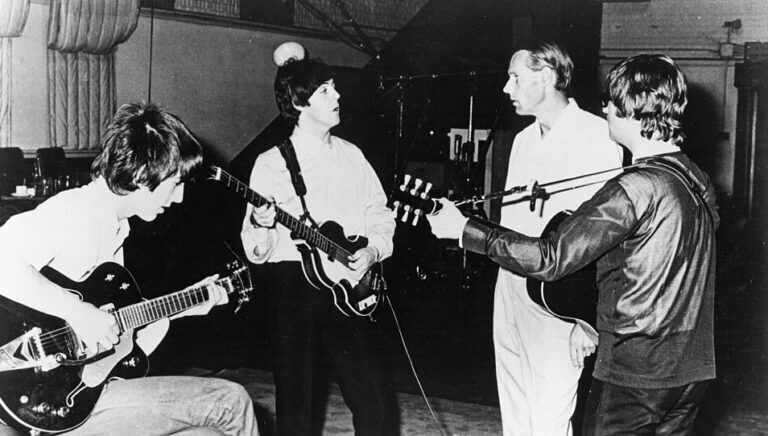
Photo: The Beatles in studio (public domain)