Follow us

“Aqualung”: Remembered, Reconsidered
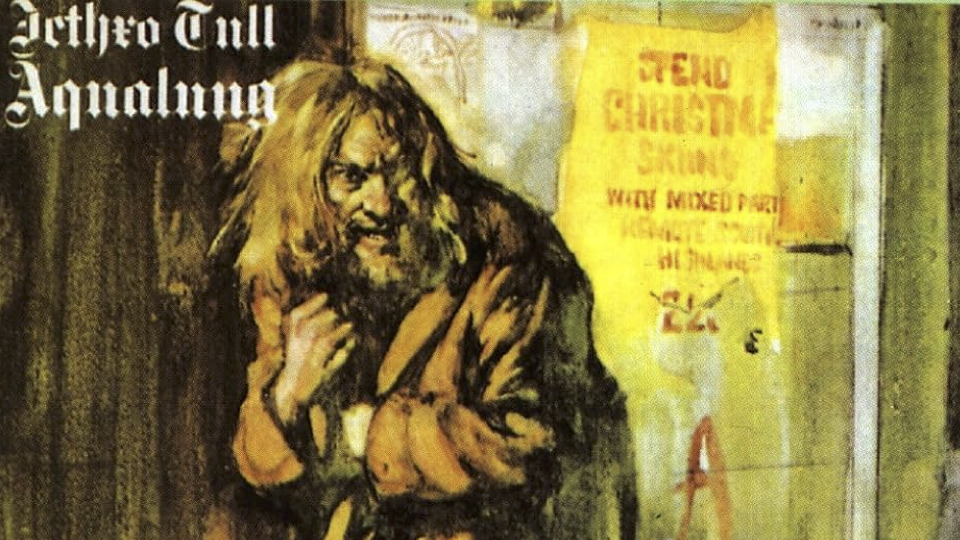
“That Jethro Tull guy likes to play the flute a lot!”, my co-worker commented upon hearing the CD I was playing. I was going to point out that Ian Anderson is the flute player and the band is called Jethro Tull, but probably thinks Rob Halford is Judas Priest and that Flo & Eddie are a married couple.

But getting back to Tull, the flute was a big part of their sound, and is still being played by their leader Ian Anderson, who is currently touring behind their twenty-fourth album, Curious Ruminant. Anderson has carried the band on his proverbial shoulders since the late 1960s. Although Tull has hit multiple music peaks, with many considering the album Thick as A Brick as Tull at their zenith, it’s the 1971 release, Aqualung, that’s stayed in classic rock rotation. It contains perennial favorites, “Locomotive Breath”, “Cross-Eyed Mary”, and the title track.
In Scott Allen Nollen’s Jethro Tull: A History of the Band 1968-2001, Anderson admitted that Aqualung is seen as the seminal Tull album. It’s continued to bring Jethro Tull to the attention of more people than any other
1971 – Aqualung – Early Seventies Milieu
In 1968, Jethro Tull started playing a lively mix of jazz, blues, and rock. Their first release, That Was, features a terrific blues shuffle, “My Sunday Feeling,” and a wonderful cool jazz number, “Serenade to a Cuckoo.”
After three albums, they developed into a progressive rock powerhouse. Music writer, Andrew Grant Jackson, regarded Tull, alongside Yes and ELP, as one of the top three British Prog bands. He wrote, “It was perhaps the most ambitious scene happening, determined to fuse rock with classical, jazz, and experimental.”
“Aqualung” is one of Tull’s most misunderstood songs. On the surface, it appears to simply be about a sinister character seeking “bad intent.” However, it’s more about social commentary, not self-regard. Written in the third person, its narrators speak for Aqualung and never allow him to tell his story.
The song begins with a riveting guitar riff and then three different vocal narrations. It begins with the first narrator’s imperious observation of Aqualung. In stentorian tones, Anderson condemns Aqualung because he’s homeless and looks guilty about something. Yet the only thing Aqualung is doing is “Sitting on a park bench.” It’s a startling beginning, and the question of whether Aqualung is guilty of something starts the action.
But then the story shifts to the next narrator, a clinically sounding broadcasting reporter who talks about “Sun streaking cold, An old man wandering lonely.” This leads to the third narrator, who reflects on Aqualung’s situation. He shows empathy while his singing sounds like an avuncular friend advising him, “Aqualung my friend, Don’t you start away uneasy.”

The story concludes with the character “sitting on a park bench,” alone with his thoughts in the cold. Aqualung never speaks for himself, and whether anyone would listen to him is suspect. He, and “poor old sod(s)” like him, remain the least of us, destined to be regarded least.
-Vincent Maganzini
Fair use image of Aqualung