Follow us

Earl Palmer: The One-Man Wrecking Crew
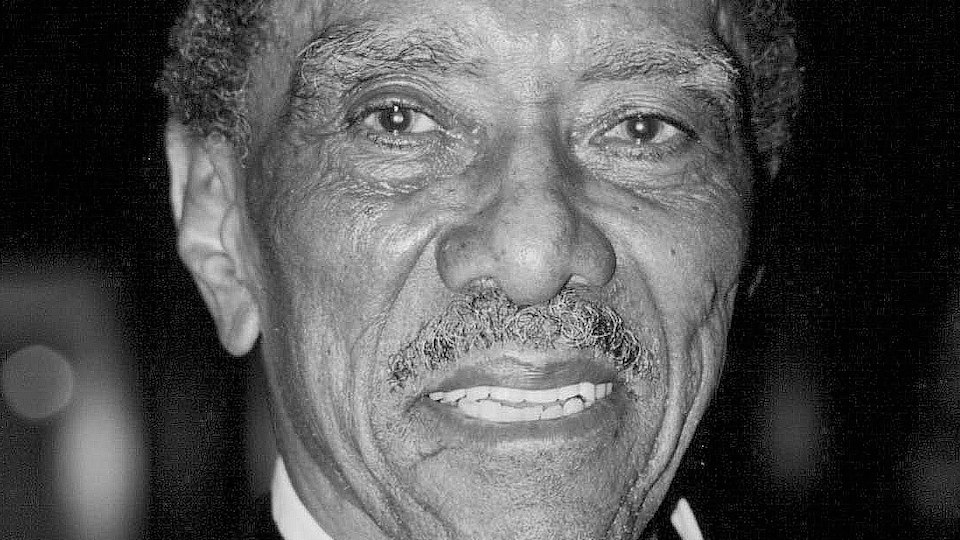
The extra-long list of songs that featured Earl Palmer on drums is an eye-opener.
In 1967, the musicians’ union listed that he played on 450 sessions. Of his time playing on Neil Young’s “The Old Laughing Lady” and “I’ve Loved Her So Long” on Neil’s 1968 debut solo album (Neil Young), Earl told Tony Scherman, author of Backbeat: Earl Palmer’s Story: “I’m telling you, man. I don’t remember it.”
He also forgot his time with Bonnie Raitt on her third album, Takin’ My Time. The album was partially produced by Little Feat’s Lowell George (until Raitt fired him). Palmer remembered him as “…a fat short guy who had this big old rustic beautiful house above a nudist colony. Them broads didn’t hide or nothing. I guess they were used to being watched! It’s a shame I don’t remember any of those sessions.”
Scherman noted that, “Earl became so busy that producers used to say if he couldn’t make the session, could they hire his drums! Earl found this amusing and asked himself if they thought the drums played themselves.”

Earl’s personality was just as pleasing as his playing. Carol Kaye, bassist extraordinaire of the legendary “Wrecking Crew,” stated, “So many kind words and memories would be told about Earl Palmer, the man. Sure, he was one of the greatest drummers in the world, but when you leave this earth, it’s better to be spoken about as ‘the person’ sometimes. He was a sweetheart.”
But before Earl, a New Orleans native, tapped a bass drum’s pedal, he was a professional tap dancer. At the age of five, he was a mainstay on the black vaudeville circuit as part of Ida Cox’s Darktown Scandals Review.
Dancing prepared him well. Earl believed: “Tap-dancing is nothing but drumming with your feet.” He pounded on Fats Domino’s “The Fat Man,” one of too many songs labelled “the first rock ‘n’ roll record.” Palmer’s description of his performance on the 1949 ditty describes what every great rock tune possesses: “That song required a strong afterbeat throughout the whole piece. With Dixieland, you had a strong afterbeat only after you got to the shout last chorus. It was sort of a new approach to rhythm music.”
Thanks to his personal approach, which was featured on numerous Fats Domino classics like “I’m Walkin’,” “Blueberry Hill,” and “My Blue Heaven,”
Little Richard approached Earl and asked him for a recording date, which Earl fondly recalled: “The first time I felt like a page was being turned was Little Richard. I hadn’t heard anything like this before. He went into that ding-ding-ding-ding at the piano, and I thought, ‘This sumbitch is wild!’ The only reason I started playing what they came to call a rock and roll beat came from trying to match Richard’s right hand. Most everything I had done before was a shuffle or slow triplets. On ‘Tutti Frutti,’ you can hear me playing a shuffle. Listening to it now, it’s easy to hear I should have been playing that rock beat.”
To the delight of British teens, Earl kept the beat to their favorite records. ELO’s Bev Bevan recalled, “I remember (Zeppelin drummer) John Bonham and I agreeing that the two best rock and roll drummers were Earl Palmer and Hal Blaine. Palmer’s drumming on Eddie Cochran’s ‘Somethin’ Else’ obviously inspired Bonzo’s intro to Zep’s ‘Rock And Roll.’”
Earl’s session work could also be heard on TV via his playing on the theme songs to The Flintstones, I Dream of Jeannie, The Brady Bunch, Green Acres, The Mod Squad, The Partridge Family, and Batman.
His expertise at “staying in the pocket” earned him the nickname “The Metronome.” He was also adept at sharp comments, like “If you can, use rationale with somebody, fine. But sometimes, you turn the other cheek, he’ll break that one too.” Or, Earl’s description of singer Wayne Newton: a “long-legged, short-torso kid.” Palmer’s first impression of rock when it rolled onto the cultural landscape? “What was rock and roll to me? I lived in a jazz world. I was not interested in Little Richard or Fats Domino.”
And even though he manned the sticks for many of Sam Cooke’s smash hits, he found Sam’s voice paled in comparison to some jazz singers. Earl proclaimed, “I don’t put Sam Cooke on the same scale as Sarah Vaughan, nowhere near. I’d have to call out fifteen singers—Sarah Vaughan, Ella Fitzgerald, Nat Cole, Billy Eckstine—and then I’d get to Sam Cooke.”

Earl, who died at the age of 83 in 2008, left behind a discography that spanned generations and genres. He rubbed shoulders with every music heavyweight, including Sinatra and Streisand. Even though Earl forgot some sessions, he remembered a certain night in New Orleans:
“There was a time when Ray Charles and (singer) Big Joe Turner and (blind singer) Al Hibbler and I were all hanging around the Dew Drop Inn doing nothing. Ray and Al got in a fight. If I recall, it was about who was going to sing first. They both said, ‘I’m going to kick you in the ass!’ and we cracked up laughing. ‘How you going to find his ass?’”
-Mark Daponte
Photo: Earl Palmer (Kingkongphoto & www.celebrity-photos.com via Wikimedia Commons)