Follow us

Rick Wakeman at 76: A Career Retrospective
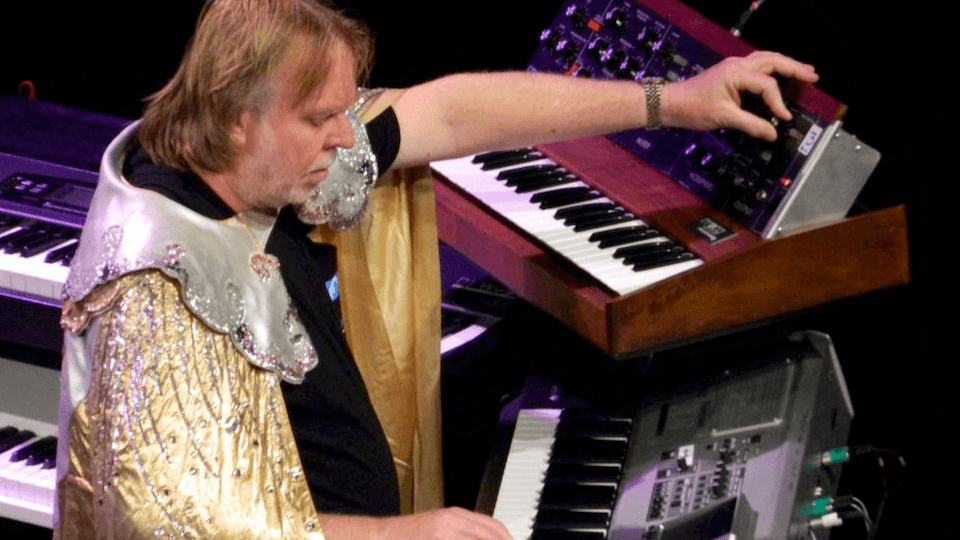
“Renaissance Man” comes close to describing legendary keyboardist Richard Christopher Wakeman, but it doesn’t quite fit. He’s an accomplished composer, keyboard wizard, and rock star, and at 76, a musical sage. He’s also a clown and an affable ham. His musicianship was a part of so many important rock and pop moments that perhaps “Stealth Session Man” is a better description for him.
As I prepared to write this article, I reviewed Wakeman’s music in two reliable sources, The 1001 Albums To Hear Before You Die and The Mojo Collection: The Ultimate Music Companion. Surprisingly, Wakeman’s 1973, The Six Wives of Henry VIII was nowhere to be found in either. TSWOHVIII is generally considered Wakeman’s strongest album, a winner filled with intricate piano and organ work, yet it’s often given short shrift.

In a recent interview with TomDoyle of Mojo magazine, Wakeman explained, “I gave the album to A&M at the end, really proud. They didn’t like it. They said, ‘Where’s the vocals?’ I said, It’s not songs, it’s an instrumental keyboard album. Their reaction was, like, ‘Oh, fuck, really?’ And the initial reviews were terrible. They didn’t get it at all. But then, as the months and years went by, they did get it.”
Though Wakeman’s musical compositions are strong, he has even greater strength in the realm of collaboration. After leaving the Royal College of Music in 1968, he joined folk rockers the Strawbs. Then he worked with Cat Stevens, notably providing the piano for “Morning Has Broken.” Extensive work with David Bowie followed. Amongst many legendary songs, his playing for Bowie on “Life On Mars” is exquisite. Along the way, he worked with Marc Bolan, Elton John, and others.
Around this time, he worked almost nonstop at Trident Studio, and then Yes summoned him. Wakeman would become an essential member. Their Fragile and Close To The Edge albums are considered their peak. Wakeman’s playing helped them achieve a brilliant orchestral sound that could be both elegant and abrasive.
Wakeman has always had a restless spirit and decided to venture out on his own. After leaving Yes (more than once), he explored theatre rock. His exploits, Journey To The Centre Of The Earth and The Myths and Legends of King Arthur and the Knights of the Round Table, were grand, bombastic productions. Even though a healthy sprinkle of subtlety would have helped these adventures, at the time, they were enormously successful.
After constant touring and recording, Wakeman became a star in his own right, but it sadly burnt him out. Heart problems and alcohol abuse cost him his health.

In the 1980s, Wakeman continued to make music with Yes and Anderson Bruford Wakeman and Howe, plus solo work. On August 8, 1985, he stopped drinking and, along with performing music, became a TV (GasTank) and radio (Planet Rock) personality in Britain. In the wonderful documentary on British progressive rock, Prog Rock Britannia, Wake provides some of the more memorable and amusing comments.
Over the past 30 years, Wakeman’s output has been vast, though not always hugely successful. In 2017, he released Piano Portraits, which was given four stars by Mojo. In 2021, he received a Commander of the Order of the British Empire (CBE). After all these years, his fingers continue to work magic, and his piano playing is something to behold. At 76, he’s going strong and has learnt to keep his hands in top condition; after performances, he will “immediately plunge them into buckets of iced water.”
Prog on, Rick!
– Vincent Maganzini
Photo: Rick Wakeman, 2013 (Aureliomoraes30 via Wikimedia Commons)









Fun read! Never realized he played on “Life On Mars”!
I was an early fan of Rick Wakeman. One E of the first songs I learned on the piano was Morning Has Broken. His synthesizer work really inspired me and in college I took an electronic music class. It was a small group of 6 or so and we used a Moog Synthesizer, an early model where you had to plug in cords much like an old time telephone operator. We were urged to create sounds and imitate instruments. That was some 45 years ago and it was a highlight of that semester..