Follow us

Sneak of the Week: Big Maybelle, “Ocean of Tears”
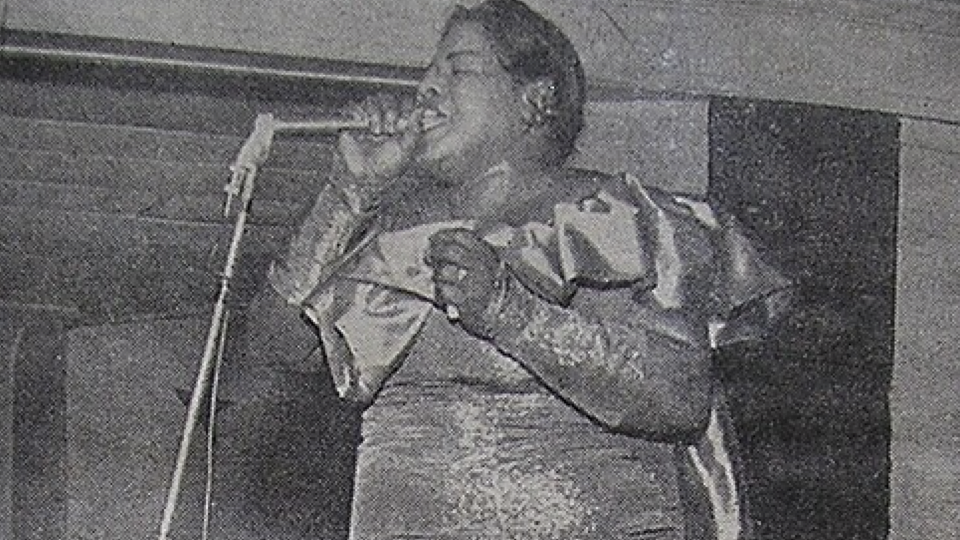
A ‘50s R&B queen turns a burning barrel of heartache upside down and shakes it.
Some of the greatest mid-century blues and R&B singers were part of the “Big” family: Big Joe Turner, Big Maceo Merriweather, Big Joe Williams, Big Mama Thornton… and Big Maybelle was fully worthy of being included in that majestic clan.

Tennessean Mabel Smith was only a child when she started singing gospel, but by the 1940s, she was an R&B belter, with a voice so powerful it could have been designated a weapon of mass destruction. Smith landed a few songs in the upper rungs of the R&B charts in the ‘50s, and at the time, anybody who was paying attention knew that her pipes were among the mightiest around. She can be seen burning down the house in the legendary documentary Jazz on a Summer’s Day, filmed at the 1958 Newport Jazz Festival.
But her career and profile never quite got to the level they should’ve, at least partly because of a heroin addiction that hobbled her on multiple fronts. She was only 47 when she passed in 1972. Fortunately, she left behind a tall stack of stultifying songs.
Inexplicably, one of Big Maybelle’s most devastating performances went unreleased until decades after her death. “Ocean of Tears,” written by Sid Wyche and Teddy McRae, was cut at a 1955 session arranged and conducted by the venerable Quincy Jones. It’s one of those blazing, minor-key R&B rhumbas that were steaming up windows across mid-‘50s America, like Roy Montrell’s “(Every Time I Hear) That Mellow Saxophone” or Otis Blackwell’s “Let the Daddy Hold You.”
But where the latter two tracks were all about raising the roof and letting your libido off its leash, “Ocean of Tears” was a different sort of beast entirely. It’s a song about heartbreak so heavy that the narrator is powerless to do anything but cry out for a salvation that sounds unlikely to arrive anytime soon.

Big Maybelle didn’t write the tune, but you can trace both its language and its melody back to the spirituals she started out with. It’s just that she’s crying out to mama instead of the Lord to help her, and the pain overwhelming her comes from lost love, not tribulations of the spirit. From her very first wails at the start of the song, Maybelle packs a lifetime’s worth of intensity into every cry. The feeling is so wracked and raw it’s unsettling, almost scary.
Having that endlessly undulating rhumba beat beneath her instead of a standard shuffle or boogie somehow makes the fate she’s bemoaning seem all the more cruel. So do the sinister, stinging guitar lines that nip at her heels like a hungry serpent. Those menacing licks emanate from the axe of Mickey Baker, who backed scads of R&B legends but is best known as half of Mickey and Sylvia, of “Love is Strange” fame.
After this session, her last for OKeh Records, Big Maybelle still had a couple of career peaks to come before her flame flickered out—the slightly salacious jazz/blues hit “Candy” and even a soul-slathered cover of ? & The Mysterians’ garage-rock evergreen “96 Tears” that became her only pop success.
“Ocean of Tears” wouldn’t see release until the 1993 box set The OKeh Rhythm & Blues Story. It boggles the brain how anyone could hear that track and not want to put it out as quickly as humanly possible. Luckily, as the sagacious MLK Jr. once observed, “The arc of the moral universe is long, but it bends toward justice.”
-Jim Allen
Photo: Big Maybelle, 1956 (public domain)