Follow us

The Epic Track: “Stairway to Heaven”
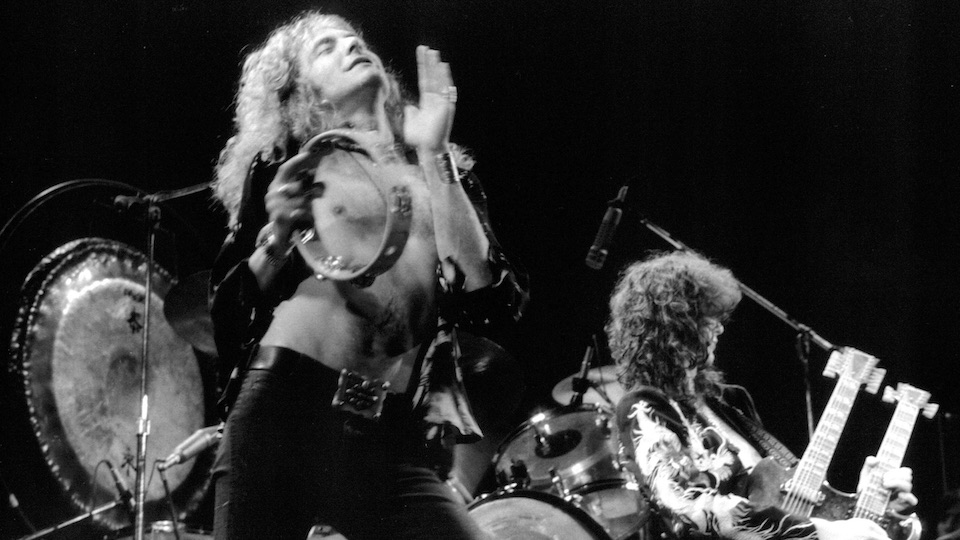
Editor’s Note: There are certain tracks that are, well, “epic” — memorable, larger than life, carved into music history. In this series, we look at one of them.
***
They’re among the most iconic opening notes in rock history. To the point where Mike Myers parodied it in Wayne’s World.
“Stairway to Heaven” regularly makes the top spot on lists of the great rock anthems. Every holiday “countdown” on my New York radio station puts it at #1. At this point, if something else took its place, there might be a rip in the Fabric of Time.
Which is ironic, considering that “Stairway” wasn’t even meant to be a single. It took hold when radio stations received the song as a mere promotion (that vinyl has since become a collector’s item).
“Stairway to Heaven” encapsulates so much about Led Zeppelin writ large: mystical lyrics, thundering chords, and howling vocals, the band members each operating at peak musicianship and inventiveness. In a 1975 interview with Rolling Stone, Jimmy Page noted, “To me, I thought ‘Stairway’ crystallized the essence of the band. It had everything there and showed the band at its best… as a band, as a unit. Not talking about solos or anything, it had everything there. We were careful never to release it as a single. It was a milestone for us. Every musician wants to do something of lasting quality, something which will hold up for a long time, and I guess we did it with ‘Stairway.’”

Released in 1971, the track had been worked on, on and off, for months throughout 1970. Jimmy Page needed a song to replace “Dazed and Confused” as the centerpiece of their live set. He originally envisioned the track running about 15 minutes; it came in at 8:03, still overly long at the time, but a perfect fit for the direction that album-oriented FM radio was taking. Besides being one of THE most-played songs in Classic Rock, the sheet music alone still sells 10-15,000 copies every year.
After touring for 18 months, Page and Robert Plant began writing it at Bron-y-Aur, a Welsh cottage they’d occupied when crafting the songs on Zeppelin 3. They eventually moved to Headley Grange, the remote, drafty old mansion beloved by musicians for its remoteness, ambiance, and awesome acoustics.
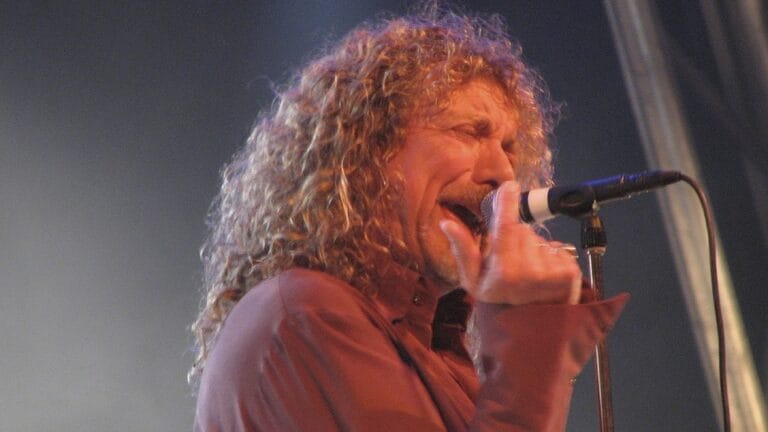
Plant was 23 years old, deeply interested in Celtic lore and magic, and the works of J.R.R. Tolkien. Whether he created this fanciful origin story for the fans or not, he recalled: “I was holding a pencil and paper, and for some reason I was in a very bad mood. Then all of a sudden, my hand was writing out the words, ‘There’s a lady who’s sure all that glitters is gold/And she’s buying a stairway to heaven.’ I just sat there and looked at the words, and then I almost leapt out of my seat.”
For his part, Page was so impressed, he let Plant write all the group’s lyrics from then on.
Needless to say, this “otherworldly” influence, combined with Page’s own interest in the occult writings of Aleister Crowley, proved to be catnip. To the point where, when Pat Boone (of all people) chose to cover the song, this rigorous Christian scoured the lyrics first for any references to the devil.
Musically, John Paul Jones added the recorder at the start, giving it an appropriately medieval folk song vibe. He skipped the bass, instead playing flute, keyboards, and adding a string section.
For John Bonham, his bit didn’t start until 4-plus minutes in. It evolved from simple time keeping to cool, jazzy fills, before his trademark thunderous drums came in at the climax.
As to that famous Jimmy Page guitar solo? He told Rolling Stone that he had a rough idea of what he wanted and an amplifier he was trying out that sounded good, so, “OK, take a deep breath and play. I did three takes and chose one of them” [reportedly, the first].
For his final lyric, Plant was to be accompanied, but it was (rightly) thought that the jaded, a cappella version was more impactful.

While Page has a deep affinity for the song, Plant refers to it as “the wedding song” and rarely, if ever, performs it, citing that it was the work of a 20-something and he’s moved past it.
Since its release on Led Zeppelin IV (aka “Zoso”), “Stairway” has been covered by dozens of artists (although…why?). Among them, Mary J. Blige, U2, the Foo Fighters, Dave Matthews Band, Frank Zappa…and even Tiny Tim.
The band does agree that two covers in particular do their song justice: Dolly Parton’s take on her 2002 Halos and Horns album is one.
Then there’s Ann and Nancy Wilson’s performance at the 2012 Kennedy Center Honors (which literally brought Plant to tears, especially watching the son of his old friend Bonzo behind the kit). [Author’s note: I have robust Sympathetic Anxiety for the dude playing Page’s iconic solo…in front of Jimmy Page…]
When it first came out, critics largely hated the song; Lester Bangs called it ”a thicket of misbegotten mush.” It was the subject of a long-running plagiarism suit by the band Spirit, who claimed Page pinched the intro from their song, “Taurus” (the suit concluded in 2020 when the Supreme Court upheld previous rulings showing no infringement).
Despite these ups and downs, “Stairway to Heaven” has burrowed into the hearts, minds, and ears of rock fans … kind of like a bustle in a hedgerow.
-Cindy Grogan
Photo: Getty